 Free Games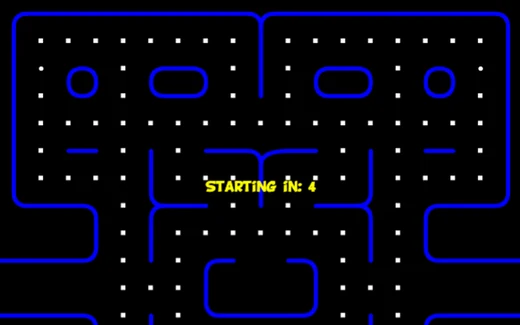
These three run on a clock of their own
Most of this site sits still and waits for you. The puzzles and the card games have no clock in them and no way to lose, so you can leave one half-finished and come back to it. These three do not work that way. The ghosts keep walking, the blocks keep falling, the snake keeps sliding, and if you stop giving them directions, something eventually goes wrong.
Each of them ends. Maze Chase ends when your three lives are gone, Falling Blocks when the stack of shapes reaches the top of the board, and Snake when it runs into its own tail (or, a long way off, when it has eaten thirty times and shows a finish card with a Play Again button on it). Then you press Start again. Losing costs nothing else: there is no countdown clock in any of the three, and no score to beat except your own. The pressure comes from the board moving, not from time running out.
Maze Chase and Falling Blocks each have a Pause button, so a round can wait while you answer the phone. Snake has none. A round of Snake is short.
What each one asks of your hands
Maze Chase is four directions and nothing else. Your runner keeps going the way you last sent it, so you tap a turn as you reach a corner rather than holding anything down. There is no button to hold and no combination to remember. You start with three lives, and the big flashing pills in the corners of the maze turn the ghosts blue for a few seconds, which is your chance to stop running away and chase them instead.
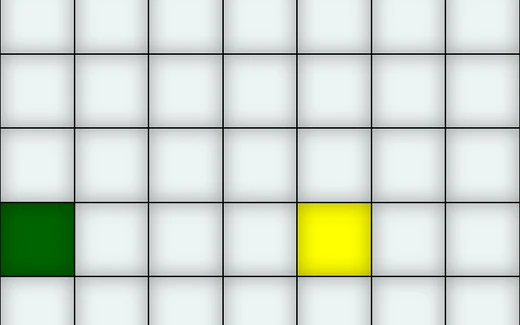
Snake is also four directions, and it is the slowest of the three to get going: about three-quarters of a second between steps at the start. It quickens after the third piece of food, and again at the sixth, tenth, fifteenth and twentieth, so the first minute is unhurried. It opens with a short How to play card. Press Start on that card to begin.
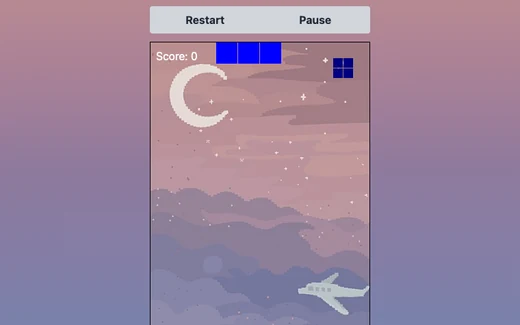
Falling Blocks asks the most, because you are doing two things to each shape: sliding it across to the gap and turning it so it fits. On a keyboard, left and right slide it, the up arrow turns it, the down arrow nudges it one row, and the space bar drops it the rest of the way. P pauses. It gets a step quicker every tenth line you clear, so the opening minutes stay slow.
On a touchscreen, only one of them has buttons to steer with
Maze Chase has four large arrow buttons below the board, with Start, Pause and Sound in a row above them, so a tablet needs nothing but taps. Falling Blocks has buttons too, but only Start and Pause, sitting above the board, and nothing to steer with. Snake gives you a Start button and nothing else.
So on a touchscreen those two are worked by dragging. Snake is steered by swiping across the screen in the direction you want to go. Falling Blocks takes a sideways drag to move the shape, a downward drag to drop it, and a tap to turn it (a quick tap, since a finger held down longer than a moment does not register as a turn at all).
That is worth knowing because it is the exception here. The games I built myself are click-to-place, with nothing dragged; these two are not like that, and a drag the game reads as a tap will turn your piece instead of moving it. If that goes badly, Maze Chase is the one to reach for on a tablet. The other two are easier on a computer, where all three take the arrow keys.
Sound, text size, and clearing the page
Above each game is a Focus mode button. It hides the header, the menus, the panel beside the game and everything written below it, leaving the game, a small Exit bar at the top, and the text-size button in the bar at the top. Escape, or that Exit button, brings the page back. What it gives you is a quieter screen rather than a bigger board, because each of the three draws its own board inside its own frame.
The text-size and contrast controls are in the Text size button at the top right of the page, marked Aa. It opens a small panel with larger and smaller text, a reset, high contrast, and a dark setting. Those change the page around the game rather than the board inside it, for the same reason. They are held in your own browser, so they are still set the way you left them next time.
Maze Chase is the only one of the three that makes any sound. It has a Sound on and off button, the S key does the same, and it remembers the choice for next time. Falling Blocks and Snake are silent.