 Free Games

What makes one of these harder than another
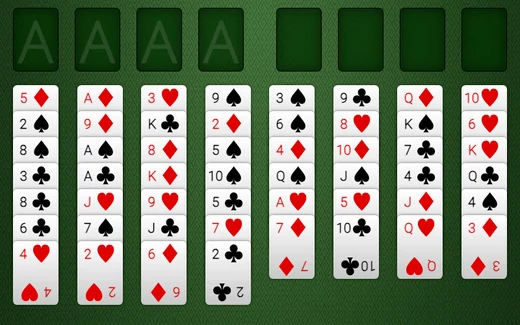
The real difference between them is how much the shuffle decides for you. Klondike deals half the cards face down from an ordinary random shuffle, so some deals cannot be won however well they are played, and a game that dies there is often the deal rather than the player. FreeCell turns every card face up before you make a move and gives you four spare cells to park a card in, so a deal that will not come out is a wrong turn rather than bad luck.
Spider is the long one. It uses two decks, and a run only leaves the board once it runs from King down to Ace in a single suit, which is why one game can fill an afternoon. Its own settings offer 1 Suit, 2 Suits and 4 Suits. One suit is patient and forgiving; four suits is the stiffest thing on this page. Starting on one suit is not cheating.
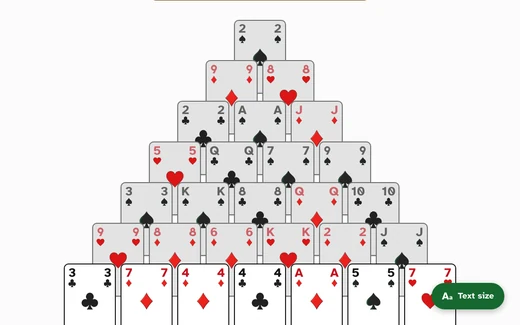
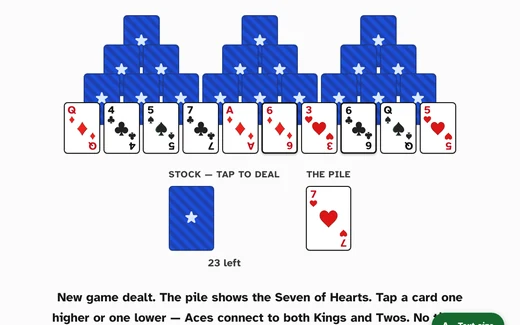
Golf, Pyramid and TriPeaks belong to a different family. Each turn asks one small question (will this card go?) rather than asking you to hold a plan in your head, and a whole game is over in a few minutes. Golf goes one step further than the rest: before a deal reaches you the computer plays it through to check that a winning path exists, and deals again if there is none.
If you have not played one of these before
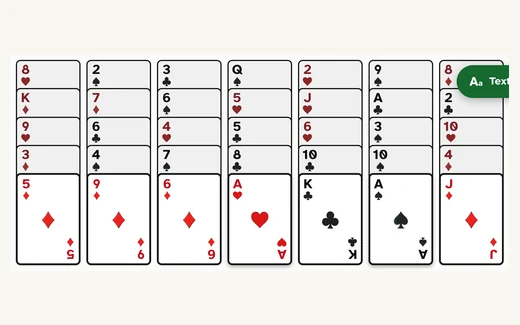
Begin with Golf Solitaire. Thirty-five cards sit in seven columns of five, every one face up, one more card starts the pile, and the last sixteen wait in the stock. Only the bottom card of a column can move, and it moves when it is one higher or one lower than the card showing on the pile. Suits are ignored, and the ranks join in a circle, so an Ace will take a King or a Two. Ten minutes of that teaches the furniture the other games use: a stock you deal from, a pile the cards land on, and columns in the middle.
Then Klondike, which is what most people mean by the word solitaire. Four foundation piles are built upwards by suit, Ace first, and the seven columns below are built downwards in alternating red and black, so a red six goes under a black seven. Cards come off the stock one at a time, and when the stock runs out the waste turns back over and you deal through it again.
Pyramid is worth trying early, because it asks for arithmetic instead of sequences. Two uncovered cards that add up to thirteen come off together: Ace with Queen, two with Jack, three with ten, four with nine, five with eight, six with seven. A King is thirteen on its own, so it goes alone. The deal pile can be turned back over as often as you want. It suits anyone who would rather add up than keep track of which card outranks which.
Reading the cards, and moving them
Card games test eyesight before they test anything else, because the whole game lives in a small number and a small symbol in a corner. Every page here carries a button marked Aa at the top right, labelled Text size. It opens a small panel holding A+ and A− for text size, a reset, a high-contrast setting and a dark setting. Klondike has one control of its own on top of that: a Bigger cards button above the board, which enlarges the cards themselves and remembers the choice for next time.
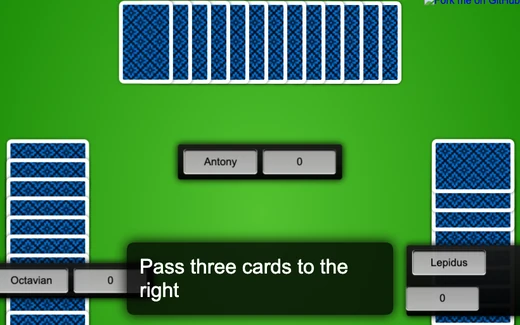
How cards move matters as much as how they look, and it is not the same in every game. In Klondike, Yukon, Golf, Pyramid and TriPeaks, which I built myself, you click or tap the card you want and then click where it should go, and between those two clicks you can change your mind and put it back. Spider is dragged: a card is held down and carried to the pile it should land on. FreeCell is dragged the same way, although double-clicking the bottom card of a column will drop it into a free cell without the carrying. In Hearts you click a card to lift it out of your hand, then press Go to play it.
Klondike, Yukon, Golf and TriPeaks can be played without a mouse. The arrow keys walk from card to card, Enter or the space bar plays or picks up the card you have landed on, H asks for a hint and U takes the last move back.
The help that is built in, and where it stops
The Hint in Klondike, Yukon, Golf, Pyramid and TriPeaks does more than point at a card. It names a move and gives the reason for it: that this card wants to come off so the face-down one underneath can turn over, that a card is safe once it is up on its foundation. You can take the reasoning or ignore it. In Klondike, Yukon and Pyramid, a second press of Hint makes the move for you. Undo in those five steps back one move at a time, as far back as you care to go.
Spider, FreeCell and Hearts came from elsewhere and work as their authors built them, which is worth knowing before you commit to a card; each of their pages carries an About this version note naming the source and the licence. Spider has an Undo and a Redo of its own, with Ctrl+Z and Ctrl+Y on a keyboard. FreeCell and Hearts have neither, so in those two a card that has been put down stays put. None of the three has a Hint button.
Nothing on this page counts down, and no game takes a turn away while you are thinking about it. Klondike, Yukon, Golf, Pyramid and TriPeaks keep no score at all, so a deal that will not come out costs nothing to walk away from. Spider can show a running clock, a move count and a score, but those readouts stay hidden until you switch them on in its settings. Hearts keeps score because it has opponents: each heart taken is a point, the Queen of Spades is thirteen, and a game finishes when somebody reaches a hundred, with the lowest score winning.