Free Games
 How to play Five Dice
Five Dice is the classic dice game built around a scorecard of thirteen categories, and this version keeps the pace entirely yours. Each turn is the same shape: press Roll to throw all five dice, look at what came up, and decide which ones are worth keeping. Tap a die to hold it: a held die shows a thick border and a printed “HELD” label so it is never in doubt which ones will change on the next roll. Press Roll again and only the dice you did not hold are thrown again. You get up to three rolls in a turn, including the first one, and you can stop after the first or second roll any time you are happy with what you have.
- The scorecard tells you the score before you choose. Every category that is still open shows the number it would earn with the dice currently on the table, and that number updates the instant you roll again. Nothing has to be worked out by eye.
- Thirteen categories, filled once each. The upper section is Ones through Sixes: each one counts how many of that number you rolled and multiplies by the number itself. The lower section is Three of a Kind, Four of a Kind, Full House, Small Straight, Large Straight, Five of a Kind, and Chance, which are described below. Once you tap a category, that score is locked in for the rest of the game and cannot be changed.
- The game ends when the scorecard is full. There are thirteen turns in total, one per category, and your grand total is shown at the bottom of the scorecard throughout.
- Tapped the wrong category? Press Undo right after, and that category opens back up with your dice exactly as they were before you chose it. Undo only reaches back one turn, so it stops working once you roll again for the next one.
The lower section categories reward specific patterns. Three of a Kind and Four of a Kind need at least three or four matching dice and then score the total of all five dice, not a fixed number, so a lucky fifth die is worth something extra. Full House needs exactly three of one number and two of another, and pays a flat 25 points. Small Straight needs four numbers in a row somewhere among your five dice (for example 2, 3, 4, 5) and pays 30; Large Straight needs all five numbers in a row and pays 40. Five of a Kind, all five dice showing the same number, is the rarest roll and pays 50, the highest single score in the game. Chance adds up whatever five dice you have, which makes it the safe place to put a roll that fits nothing else.
What most people get wrong the first time back
The most common surprise, even for people who played this years ago, is the upper section bonus: fill Ones through Sixes with an average of three of each number and your upper total reaches 63, which earns a bonus of 35 points on top, more than most single lower-section categories are worth. It is easy to dump a weak roll into the upper section without noticing you are drifting away from that bonus, so the scorecard keeps a running upper total in view the whole time you play.
The second surprise is that a category can be chosen even when it scores zero. If your dice do not fit any open category well, you are still allowed, and often better off, filling in your weakest one for nothing rather than leaving it to the very end of the game, when you may have no good options left at all. Press Hint if you are unsure which one to give up: it looks at what you have open and explains its reasoning rather than simply naming an answer.
What makes this version comfortable to play
The dice are drawn as large pips rather than small printed digits, at a size that stays clear on a phone or a tablet without leaning in. Holding a die is a single tap, releasing it is the same tap again, and the held state never relies on colour alone: a thick border and a printed word sit alongside the colour change, so the state reads the same whether or not colour is easy to tell apart. Nothing is timed. The game waits exactly as long as you like between rolls, between turns, and between games, and no score or history is kept anywhere once you close the page.
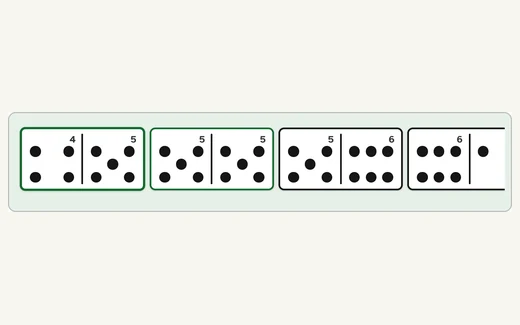
Dominoes has the same unlimited Hint that explains itself.
Frequently asked questions
- How do I play Five Dice?
- Press Roll to throw all five dice. Tap any die to hold it, which keeps its number, then press Roll again to reroll the rest. You get up to three rolls in a turn. When you are happy, tap a category in the scorecard below to lock in that score. There are thirteen categories in all, and a game ends once every one is filled.
- How do I know what a category is worth before I choose it?
- Every open category in the scorecard shows the number it would score with the dice sitting on the table right now, and that number updates after every roll. There is nothing to work out in your head: if Full House shows 25, choosing it scores 25.
- What is the upper section bonus?
- The six categories at the top (Ones through Sixes) each score by counting how many of that number you rolled. Add three of each number across all six and you reach 63, which earns a bonus of 35 points added to your total. The scorecard tracks your progress toward it as you go.
- What if none of my open categories score anything?
- It happens on an unlucky roll. Press Hint and it will point you toward one of your lowest-value open categories to use up now, so the categories worth more stay open for a better roll later, and it explains why.
- Is there a timer, and is it really free?
- There is no timer and nothing is recorded between games. It is free, and you do not need to sign up, give an email or download anything. There are no pop-ups and nothing that sits over the dice or the scorecard. To keep the site free I may show a few small, clearly-marked ads off to the side.
Where Five Dice came from
Games scored by rolling five dice and rerolling some to build hands like a straight or a full house have been played for pocket change since at least the 1930s, often under the name Yacht. The format needs nothing but five dice, a cup and something to keep score with, which is probably why so many households ended up with their own version and their own house rules.
The best known member of the family, Yahtzee, was trademarked and sold from 1956 by game maker Edwin S. Lowe, who by his own account bought the idea from a couple who had invented a five-dice game to play with friends on their yacht. My game follows that same family of rules, rolling and holding dice toward a scorecard of categories, without being tied to one company's name. Play it alongside my other board games.